If you’re reading this, there’s a good chance you’ve been walking some part of this road with us already. You’ve prayed for us, sent texts, dropped off meals, hit “like” or “heart” on pictures of Traci and I smiling at Disneyland or sitting in yet another hospital room. This chapter is for you, and for the version of me who will look back one day and try to remember how it felt to sit in this exact chair, next to this exact ICU bed.
As I type this, Traci is a few feet away from me in the neuro ICU. Machines are humming, nurses are doing what Traci and I affectionately call “the vampire rounds,” and we are in that strange in‑between space of being both grateful and scared at the same time. Grateful, because we narrowly avoided a surgery that could have taken her from us. Scared, because we’re still very much in the woods. And also hopeful because there is a path ahead of us where recovery is a possibility, and we are clinging to that path as tightly as possible, actively working hard toward the road to recovery.
To understand how we got to this room today, you kind of have to zoom out. It’s been a while since I’ve told stories of this type in this format and I want to give it the air it deserves. This isn’t where her story with cancer started, and it’s not even where the brain part of the story started. This ICU bed is just the latest stop on a road we never asked to drive, but have been trying to navigate with as much courage, faith, and frankly, stubborn joy as we can find.
Long before this ICU room, Traci and I were already veterans of waiting rooms, scan days, and hard conversations. Her original tumor sat in a brutal spot, tucked down at the base of her skull and neck where surgery wasn’t really an option. The plan back then was simple on paper and absolutely savage in real life: thirty‑three radiation treatments, plus chemo, aimed at something you can’t see or touch but you know is trying to take the person you love.
Those weeks are still somewhat of a blur in my head made up of hospital hallways, IV Poles, and that specific kind of tired that doesn’t go away with sleep. Traci did what she’s always done: she showed up, day after day, even when every part of her hurt and the finish line felt fake. I watched her lose weight, lose hair, lose energy…and somehow not lose that little spark in her that keeps saying, “We’re still blessed. I am surrounded by people I love and who love me. God is still good.”
And then, against all the fear and all the statistics running quietly in the background of my brain, the treatments did what they were supposed to do. The scans came back improved in that original area. The thing we had all been aiming every beam and pill at was gone. We walked out of those appointments with this mix of disbelief and relief, like we were being handed more time than we’d dared to ask for.
The tradeoff was stepping into a new kind of life: one built around scans every 90 days and follow‑ups with a number of different docs. In between mitigating all the side effects of the treatments, every three months she would head back into the machine. Every three months, a fresh chance to hear “everything looks stable” or “we’re seeing something new.” We learned to live between those appointments, to plan trips and birthdays when the body felt up to it, and eventually bring back Disneyland days around a calendar that always had the next scan circled in quiet red in the back of my mind.
That rhythm became our “new normal.” Not the life we would’ve picked, but the one we were given, and we tried to fill the space between appointments with as much regular life and as many small joys as we could, and when her endurance would permit.
For a little while, that rhythm of ninety‑day scans actually held. We’d go in, hold our breath, and walk out with some version of “things look stable.” And then September 2025 came, and the scan didn’t give us the easy answer.
They found a new spot on the right frontal lobe of Traci’s brain. Same disease, new neighborhood. The team was calm, which helped us stay mostly calm. They believed this particular spot was treatable with a single, focused dose of radiation. After everything she had already survived, one dose felt almost…manageable.
The Radiation Oncologist basically explained it as playing a game of Whack-A-Mole. A new spot pops but, and we go and get it. So she did it. One more mask, one more session in a machine, one more act of faith that this invisible beam was going to hit what it needed to hit. And in the months that followed, that little area did what the doctors hoped it would do: the disease in that spot was effectively eliminated.
But radiation is never a sniper rifle. It doesn’t only touch the bad cells; it hits some of the good ones standing nearby, too. When Traci went in for her follow‑up scan in January, the images started to show the cost of that “friendly fire.” There were signs of swelling and necrotic tissue around that treated area — damage from the very thing that had saved her.
By April, another scan showed that the swelling had increased. On paper, that’s the kind of sentence that makes your stomach drop. In real life, it was complicated, because Traci still wasn’t having the major red‑flag symptom everyone watches for: the crushing headaches that scream, “This is an emergency.” So the plan, at that point, was to keep watching, keep scanning, and keep living life in between, even as this quiet pressure was building inside her skull.
After that April scan, life turned into this weird split‑screen. On one side, we were deep in wedding countdown mode for Abby. Final fittings, last‑minute timelines, speeches to write, trying to make sure our girl got the fairytale day she deserved. On the other side, I was watching Traci fade in ways that were hard to explain on a spreadsheet, but impossible to miss if you lived with her.
Her stamina kept dropping. The walks around the house got shorter, the transfers got slower, the pain and nausea crept higher. Little things that used to be “hard but doable” started moving into the “this might break her” category. Palliative care tried to keep up, but there’s only so much you can do when the problem lives inside a swollen, irritated brain. She was still Traci — still kind, still funny in these quick flashes — but more and more, it felt like I was only getting pieces of her through a fog.
At the same time, we were saying yes to as much normal life as we could manage. Bridal appointments for two brides! Family events. Planning out how to get her to the Disneyland Hotel, or into the right outfit for the wedding, and onto a dance floor for the party. I was constantly doing the math in my head: how much can we ask of her body without breaking it, and how do we buy her enough strength to show up for Abby on the days that really matter?
From the outside, it probably just looked like a busy family in a hard season, trying to juggle big milestones and a serious diagnosis. From the inside, it felt like balancing on a beam where one wrong move could send us straight into crisis. We could all feel the ground shifting under our feet. We just didn’t know yet how quickly it was about to give way.
In the middle of that slow downhill, the doctors did something I will be grateful for as long as I live: they hit pause. A couple days before the wedding things dipped low enough that we stopped into the ER to check her vitals. They came back ok, but the CT scan showed a clearly alarming picture. They knew her brain was swollen, but the scan from April was small swelling compared to where we were now. They knew we were close to a cliff. And they also knew Abby was about to get married at the Disneyland Hotel. So the plan quietly bent around that reality. The focus became simple and razor‑sharp: get Traci to the wedding, get her through the big moments, and let our girl have the day she’d been dreaming about.
Somehow, against every odd, we pulled it off. Traci made it to the rehearsal and the family dinner. She got her hair and makeup done by Nikki’s “glam squad” hands. She put on her wedding outfit and I stopped and took a moment to drink it in. I wept.
And then we moved forward with the day. She rolled through the lobby of the Disneyland Hotel like the bravest queen I know. I got to ride with Abby in a Cinderella carriage, tell her how much I loved her, and then walk her down the aisle to Andrew. Traci watched our baby girl get married. There are a lot of medical words in this story, but that sentence is the one that matters most to me. We had to cut out a little earlier than desired because she wasn’t doing as well in the evening. Rightly so as she was exhausted. But we got to check every important box and it was a magical evening.
The next morning we were ready to face the reckoning and head to the hospital when there was one more miracle: she made it to the brunch in the Mark Twain ballroom at the Disneyland Hotel. Our whole entire crew of people gathered on a quiet room at a table together in the middle of Disneyland, eating breakfast and telling stories while the cavalcade of tourists marched by in what felt like a world away. Traci sat in her wheelchair, exhausted but present, wrapped in love. If you looked at just that weekend, you could almost believe this was just a regular family in a regular hard season, celebrating a wedding at the happiest place on earth.
And then Sunday afternoon, the other screen took over.
By the time we left from brunch, it was clear her body had spent everything it had been saving. The confusion, the weakness, the subtle slips we’d been tracking for weeks all slammed into a wall. We ended up doing the thing we’d been hoping to avoid for as long as possible: we left the Disney bubble, drove straight past our little “mission HQ,” and checked Traci into the ER at the Kaiser in Downey. Within hours of admission, she was in the ICU and we had a team of medical professionals dealing with critical brain swelling, and we were suddenly living in a room full of monitors and “vampire” lab draws, trying to figure out if this was the beginning of the end.
By Sunday night, that’s where we were living. Traci in a bed ringed with pumps and monitors, me in the standard‑issue chair pulled right up next to her, and her dad Phil with us there too. Our whole world shrunk down to one room and a parade of people in scrubs. The same brain that had quietly carried swelling for months was now the center of everybody’s attention. Numbers on screens suddenly mattered more than anything on my calendar.
The first conversations were blunt. Scans showed severe brain edema around that old radiation site. The doctors walked us through what that could mean: pressure, seizures, loss of basic functions, the possibility that her brain could simply stop telling her lungs to breathe if things kept getting worse. Surgery was on the table as a maybe, but a terrifying one — high risk, uncertain reward, and no take‑backs if her already‑battered body couldn’t handle it. It felt like standing at the edge of a cliff with fog hiding the drop.
So they did what they could do right away. Steroids. Anti‑seizure meds. IVs. Hourly neuro checks where nurses would shine lights in her eyes and ask her to squeeze their hands or lift her legs. They drew blood so often we started calling them “the vampires.” Every few hours someone new would step in with a different badge and a different piece of the puzzle. My job, in all of it, was to listen, ask questions, and keep saying some version of the same sentence: “Her baseline has crashed. Something is really wrong.”
In between all of that, there were these quiet pockets that felt almost sacred. Traci dozing, her hand in mine. Pictures showing up on social media on our phones full of images and videos from the Disneyland Hotel, the walk down the aisle, and even the breakfast taken literally hours before she landed in this bed. Abby off on her adventures at Club 33. The girls texting and calling, trying to understand how we went from carriage rides to critical care in a single day.
We didn’t know yet what the MRI would show. We didn’t know if we were buying time, buying nothing, or somehow buying a way forward. All we knew was that the fight had moved from “let’s get Mom to the wedding” to “let’s keep Mom here at all.” And for the moment, that meant breathing with the beeps, trusting the team around us, and settling in for a kind of waiting we had hoped we wouldn’t have to do again.
The MRI was the fulcrum everything tilted on.
Going into it, the working fear was that this was potentially new disease. That the spot they’d zapped in September had come back angry, or that something else had woken up in her brain. All the conversations had that quiet, braced tone you hear when doctors are already mentally preparing you for bad news. We were talking about “mass effect” and “progression” and what you do when the cancer decides it’s not done with you.
What the MRI actually showed was something different. All along this was what her care team had assumed and seen without confirmation: the swelling was a result of necrosis and radiation fallout. In plain English, the September treatment had done its job on the tumor, and now the collateral damage was catching up. The tissue around that old site was basically fried and swollen, clogging up the works. It was awful news in one way — this was still serious, still dangerous, still capable of stealing functions and even her life — but it also meant we weren’t staring down a brand‑new enemy. We were dealing with the wreckage from the last battle.
That’s when a new drug called Avastin entered the picture.
Instead of rushing her into a high‑risk brain surgery she might not survive, the team laid out a different plan: an aggressive oncology infusion drug designed to starve off some of the blood supply feeding that angry, swollen tissue. No guarantees, no magic, just a shot at turning the pressure down without opening her skull. The tentative plan was to administer this new med with approximately six to twelve months of treatments, every few weeks. A long, grinding road that lived somewhere between “cure” and “giving up,” in that strange middle space we’ve gotten way too familiar with.
For me, sitting in that ICU room, it felt like someone quietly moved us from a cliff edge to a narrow, dangerous path along the side of the mountain. Traci still might not make it. The swelling might not respond. We might be buying weeks or months instead of years. But we suddenly had a plan that didn’t involve flipping a coin in an operating room. We had something to do, some way to fight for more borrowed time, especially with Kelli’s wedding just a few months out.
So we said yes. Yes to Avastin. Yes to more infusions. Yes to another season of hospital rooms and IV poles and hoping her body has one more stretch of fight left. And once that decision was made, the question quietly shifted again: not “is she going to survive this week,” but “what can we do with whatever time this buys us next.”
Once the MRI dust settled and the plan shifted from “maybe brain surgery” to “long haul with Avastin,” the ICU stopped being the only place she needed to be. She’d cleared the worst neuro hurdles, her numbers were more stable, and the team started talking about transferring her to a regular floor. That sentence sounds small, but in hospital language it’s huge. It means they’re no longer expecting her to crash minute‑to‑minute. We’re not gearing for a major surgery and the brain seems to be stable for the most part. Not definitively better but also not worse. It meant we’re not living on the edge of the cliff in the same way.
In real life, though, we’re still here.
They put in the order to transfer her. They told us she was going “up to the floor.” And then…nothing. No rooms. No empty beds. Just a backlog somewhere in the hospital and us living in limbo. By the time I’m writing this, it’s been almost twenty‑four hours since they said she was ready to go, and we’re still in the same ICU room, same walls, same view, only now with a different label over her name.
That’s the weird tension of this moment. We’ve been handed this huge mercy — it’s necrosis, not new disease; Avastin, not immediate surgery; stable, not critical — and at the same time, nothing around us has actually moved. The lights still stay dim. The whiteboard still has “ICU” written on it. Nurses still duck in and out, even if it’s not as frantic as that first night. We’re technically on a different rung of the ladder, but our feet haven’t left this step yet.
So we do what you do in a holding pattern: we wait. We watch the door every time a cart rattles by, wondering if this is finally the transport team. We answer the same questions again. We reminisce about the amazing wedding for Abby and Andrew that just was, and talk about Kelli’s wedding coming up, and Avastin schedules, and what “six to twelve months” of this might even look like. And underneath all of it is this quiet, stubborn gratitude that we even get to be bored in the ICU, that we are talking about bed availability instead of ventilators and last words.
Because as strange as it sounds, being “stable but stuck” here is its own kind of gift. It means there might actually be a “next” to write about.
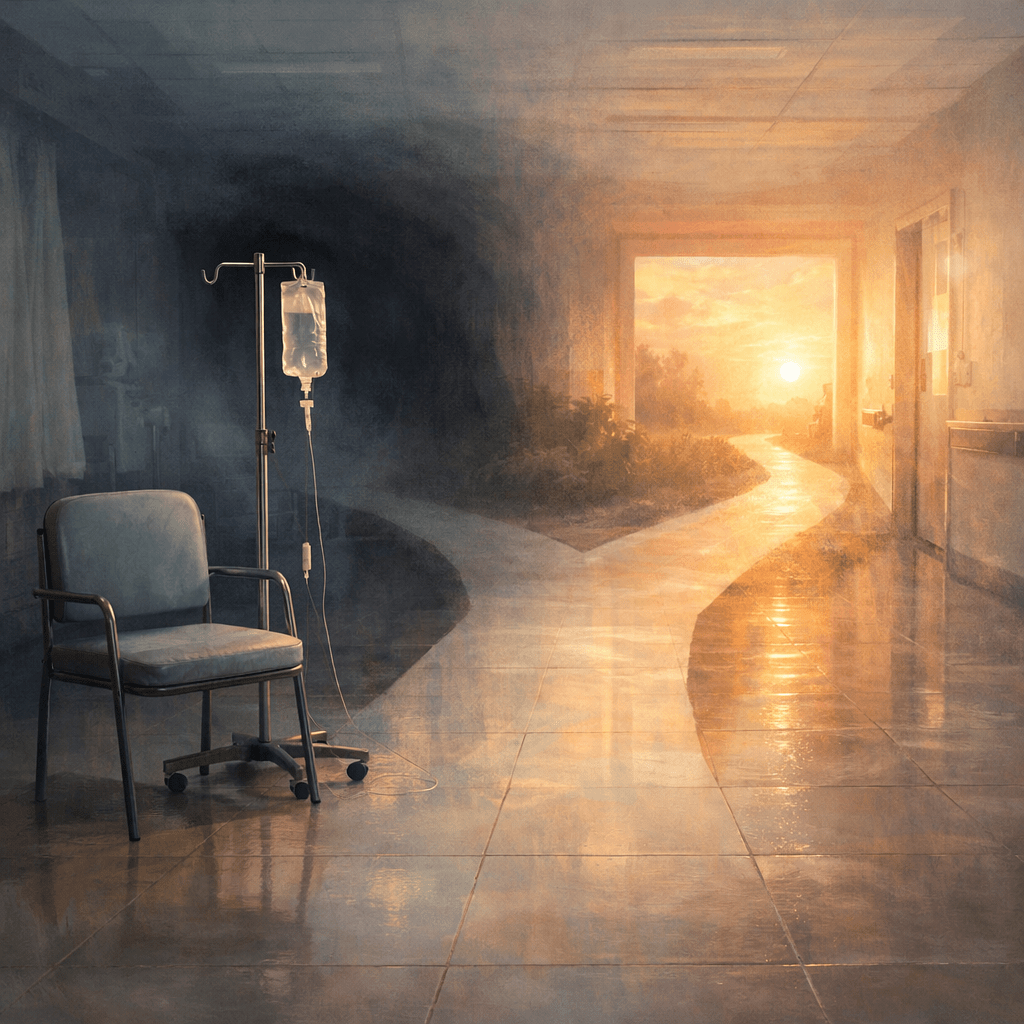
We’re not out of the woods. But for the first time in a while, we can at least see the fork in the trail instead of stumbling around in the dark. One path is still terrifying: the slow, progressive swelling keeps going, symptoms stack up, and somewhere down that road we’re back to talking about brain surgery. Because of the Avastin, even that worst‑case path now has a built‑in pause — at least six weeks off the drug before anyone would go near an operating room.
The other path, the one we’re choosing to aim our hearts toward, is the path where things slowly get better. The swelling eases. The confusion backs off. Strength and words and personality start drifting back toward our strange little “new normal.” It’s not a miracle cure, it’s just…movement in the right direction.
So that’s where we live right now: somewhere between those two trails. Scared, because we’ve seen how fast things can turn. Hopeful, because we’ve also seen what mercy looks like in the middle of the worst days of our life. And as long as there’s a path that leads toward more time, more weddings, more borrowed days together, we’re going to keep walking toward it.


Leave a Reply