Every builder I know has a story like this.
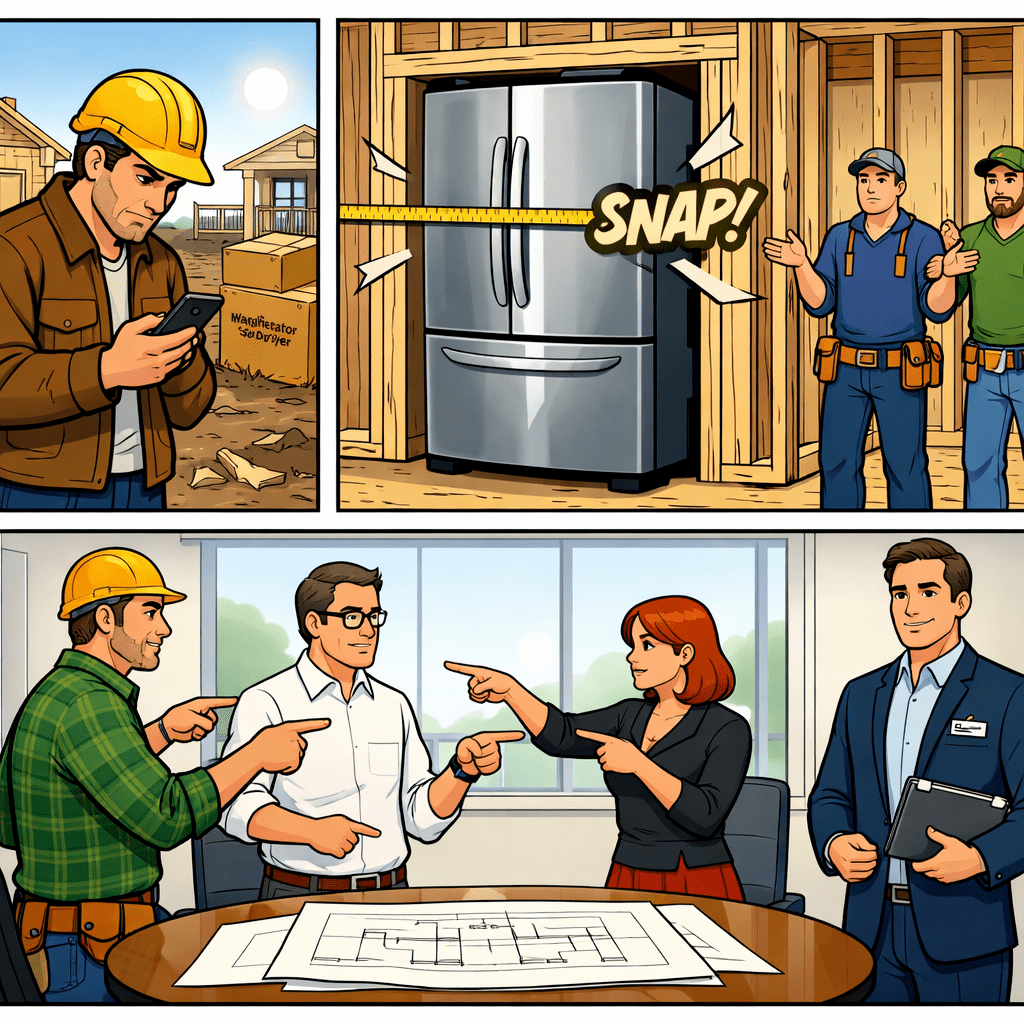
You’re walking a near-finished home with a buyer. Drywall’s painted, floors are in, cabinets look great. They open the beautiful new fridge…and the door smacks the wall before it gets halfway. Or the range door drops and barely clears the island. Or the electrician roughed in for a standard outlet and the built-in fridge needs something completely different.
Nobody cut corners. Everyone did their job. And still, you feel that little knot in your stomach because you know what it means: delays, re-work, and an annoyed homeowner.
After 15 years in appliances and home tech, I’ve learned that most of these “uh-oh” moments aren’t bad luck. They’re patterns. I see the same three mistakes over and over in new builds—and the good news is, they’re totally avoidable.
**Mistake #1: Picking (or Swapping) Appliances Too Late**
On paper, it sounds harmless: “We’ll pick the appliance package later.” Or, “We’ll just swap that model if it’s backordered.”
In reality, that’s how you end up with a 48-inch built-in trying to land in a 42-inch opening, or a vent hood that wants 10 inches of clearance above the cooktop and gets… seven.
I’ve walked into gorgeous kitchens where everything is dialed in—until you actually try to install the appliances that were chosen after framing, plumbing, and electrical were already set. Suddenly you’re moving outlets, cutting cabinets, changing trim, and taking a perfectly good plan and forcing it to fit something it was never designed around.
How to dodge it: lock in real models early, not “something like this.” Pull actual spec sheets into the planning phase and build around real numbers instead of guesses. If something has to change later, treat it like a real design change, not a casual swap—because your job site will feel the difference either way.
**Mistake #2: Planning Clearances, Power, and Venting on Assumptions**
Here’s another common scene: the fridge fits in the hole, but the doors don’t open far enough for the drawers to pull out. Or the beautiful slide-in range goes in and the gas line is right where the unit wants to sit. Or the hood is installed, but the ducting doesn’t match what the actual product was designed for.
Nobody did anything “wrong.” They just worked off a generic idea of what a range or fridge “usually” needs, instead of the specific units that are actually going in.
How to dodge it: tie clearances, power, gas, water, and venting directly to the real appliances, not placeholders. That means rough-in diagrams, not just a line saying “range here.” If you don’t have time to chase all that down yourself, make sure someone on your team—or your appliance partner—is literally matching product specs to plans before walls close up.
**Mistake #3: No One Owns the Appliance Story from Start to Finish**
This is the one that quietly causes the most pain.
On a lot of projects, “appliances” live in the gaps. Designers pick looks. Superintendents worry about timing. Office staff deal with POs. Someone at a retail store takes the order. Then a completely different team delivers. If something changes or goes wrong, everyone assumes someone else is handling it.
That’s exactly the problem the WDC Builder team exists to solve.
At WDC, there’s a dedicated Builder Division whose entire job is supporting builder deals from the very first conversation all the way through final delivery. This isn’t “call the store and hope for the best.” It’s a full, end-to-end system built for jobsites, not walk-in retail.
Here’s what that looks like in real life:
– A dedicated team of professionals who live in builder projects all day long. They’re not bouncing between Saturday shoppers and your 20, 100, or 1,000 unit build—they’re focused on people like you.
– A proven process that covers the whole transaction, soup to nuts: quoting with spec provisions, ordering, warehousing, scheduling, delivery, and follow-through. Even a property management division to service large multi family developments for years to come!
– A massive Southern California warehouse with staff whose job is to exclusively manage the complexity of builder inventory and staging, not just whatever came off the last truck.
– A fleet of dedicated trucks that exist solely for business deals—independent from the retail side—so your delivery schedule isn’t competing with Mrs. Jones’s single washer/dryer.
– A scheduling and project management team coordinating all the moving parts, so there’s actually someone watching the whole sequence instead of hoping it all lines up.
The result is simple: fewer “oh no” moments, more smooth handoffs, and appliances that just…show up when and how they’re supposed to, and get installed by professional technicians.
On top of that, the Builder Division has special builder pricing structured for projects like yours. It’s not “whatever’s on sale this weekend.” It’s consistent, competitive pricing designed for people doing real volume work, backed by a system that’s built to protect your schedule and your margins.
**Why I Joined This Team**
This is a big part of why I made the jump to WDC’s Builder Division.
After years on the retail side, I kept wishing there was a way to give my builders true end-to-end support instead of patching things together between a store, a warehouse, and whoever picked up the phone that day. WDC had already built the system I wanted: a dedicated team, dedicated trucks, dedicated warehouse space, and a process that starts with your plans and follows you all the way through fulfillment, no matter how many phases or how long that process takes.
My job now is pretty simple: connect good builders and contractors to that machine, so your projects go smoother and appliances stop being the fire drill at the end.
**Want to See It in Action?**
If you’re a builder or contractor in Southern California and any of these three mistakes sounded uncomfortably familiar, I’d love to take a look at an upcoming project with you.
Let me quote your appliance package and walk you through how our Builder team would support it—from the first spec to the final delivery. No pressure, no “hard sell,” just a chance to see what it feels like to have a dedicated team, a proven system, and a full support structure behind your appliance line.
If it saves you even one headache walk-through, that’s a win in my book.


Leave a Reply